
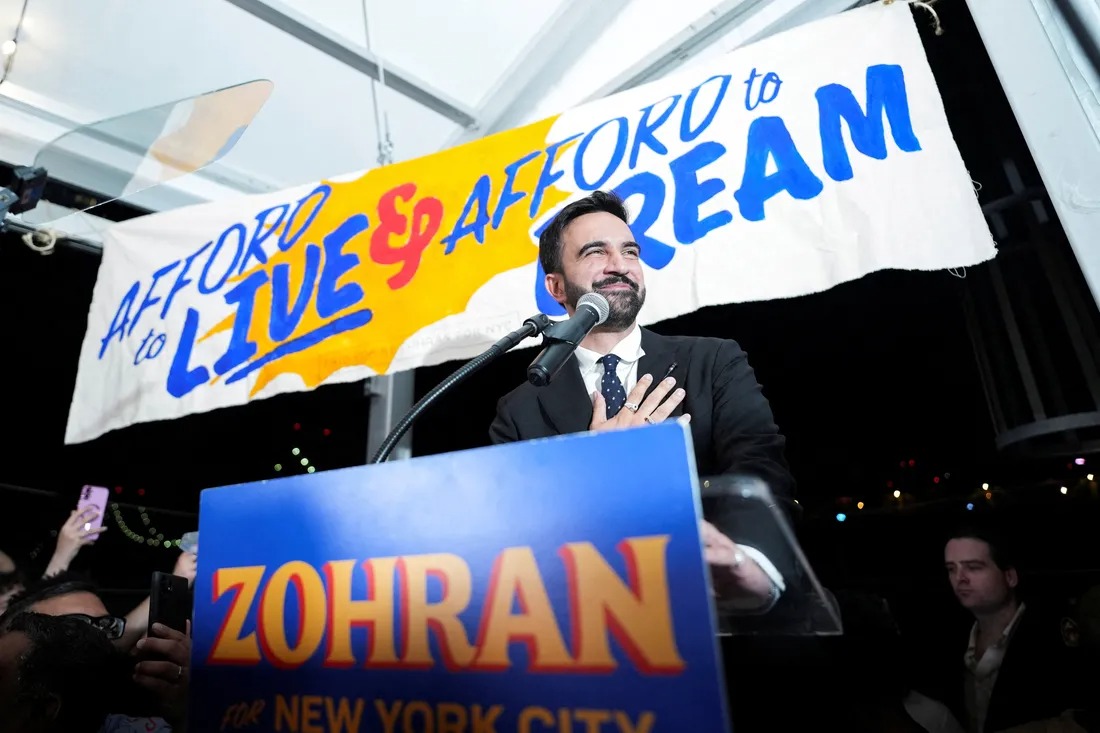
Sitting among hundreds of Jewish New Yorkers at Kolot Chayeinu, a progressive Brooklyn synagogue, Zohran Mamdani was greeted not with skepticism or silence, but with cheers and applause. The moment, which unfolded during the Erev Rosh Hashanah service last month, was more than just a campaign stop. It symbolized the complex balancing act that defines Mamdani’s bid for New York City mayor — an unapologetically pro-Palestinian candidate seeking to lead a city with the largest Jewish population in the world outside Israel.
As the Democratic nominee heads toward the November 4 general election, Mamdani’s approach to engaging Jewish communities — while maintaining firm anti-Zionist convictions — has drawn both admiration and outrage. His effort reflects not only a new phase in New York politics but also a changing dialogue within American Judaism itself, one increasingly fractured over Israel and the boundaries of political dissent.
A Progressive Path Built on Principles
Mamdani’s views on the Israeli–Palestinian conflict have been consistent since his college years at Bowdoin, where he founded a chapter of Students for Justice in Palestine. Over a decade later, those convictions have become both the cornerstone of his progressive credibility and the lightning rod of his opposition.
He’s received enthusiastic support from progressive Jewish groups such as Bend the Arc, Jewish Voice for Peace (JVP) Action, and Jews for Racial and Economic Justice (JFREJ) — organizations that have been critical of Israel’s policies in Gaza and the West Bank. For these groups, Mamdani’s stance represents a moral alignment between social justice and solidarity with Palestinians.
Beth Miller, political director of JVP Action and a member of Kolot Chayeinu, described the excitement at seeing Mamdani at the Rosh Hashanah service.
“He was basically swarmed at the end because people were so excited that he was there,” said Miller. “And that’s not because he’s a celebrity. It’s because people are excited about what we can all build together if he becomes mayor.”
Navigating Political Minefields
Still, Mamdani’s relationship with New York’s Jewish electorate is anything but simple. He has faced intense criticism from pro-Israel Democrats, far-right commentators, and Zionist advocacy groups for his support of the Boycott, Divestment, and Sanctions (BDS) movement and his refusal to recognize Israel as a Jewish state.
Despite that, recent polls suggest his outreach is working. A Zenith Research survey from July found that Mamdani led his opponents by 17 points among Jewish voters, even outpacing competitors in scenarios where incumbent Mayor Eric Adams dropped out of the race.
“No group is a monolith,” said Adam Carlson, Zenith’s founding partner. “What we found was a better-than-expected result for Mamdani among Jewish voters in New York City.”
Carlson attributes this to both demographic nuance and Mamdani’s strategic outreach to liberal congregations that are increasingly critical of Israel’s actions in Gaza.
Val Vinokur, a professor at The New School and director of Jewish Culture Studies, observed that Mamdani has “modulated his rhetoric” to appeal to progressive Zionists without alienating his anti-Zionist base — a move that has “made him more palatable” to some while angering others.
A Rhetorical Tightrope
One of Mamdani’s most controversial moments came over the phrase “globalize the intifada,” a rallying cry used by pro-Palestinian activists. The slogan has sharply divided opinion — seen by some as a call for international solidarity and by others as incitement to violence.
Before the June primary, Mamdani refused to denounce the phrase, but later told The New York Times he would “discourage” its use. His nuanced shift underscored a careful political recalibration — maintaining moral conviction while softening language for a broader electorate.
That same balancing act was evident in a social media post on the second anniversary of the Gaza war. Mamdani condemned Hamas’s October 7 attacks but also labeled Israel’s response “genocidal,” calling for an end to collective punishment.
“It got s*** on from all sides,” Carlson said. “He made nobody happy, which in my mind, is kinda the correct way to go about it. Sometimes, pleasing nobody is the job of the mayor.”
Building a Coalition Beyond Orthodoxy
For all the controversy surrounding his positions, Mamdani’s success reflects a growing generational and ideological shift within Jewish New York. Progressive congregations and younger Jews — particularly those shaped by movements like Black Lives Matter and anti-occupation activism — are increasingly aligning their faith with global social justice causes.
That coalition has powered Mamdani’s campaign. His 50,000-strong volunteer army, backed by grassroots Jewish and Muslim organizers alike, represents a new model of interfaith political mobilization — one that challenges decades of assumptions about Jewish voting behavior in New York City.
“Sometimes, you have to piss off everybody a little bit for compromises,” Carlson said. “That’s what being mayor of New York is.”
As Mamdani moves closer to Election Day, his ability to hold together this fragile, ideologically diverse coalition will likely determine whether he can transform moral conviction into political victory.
For now, his campaign stands as a litmus test — not just for progressive politics, but for the future of Jewish political engagement in America’s most complex and pluralistic city.
